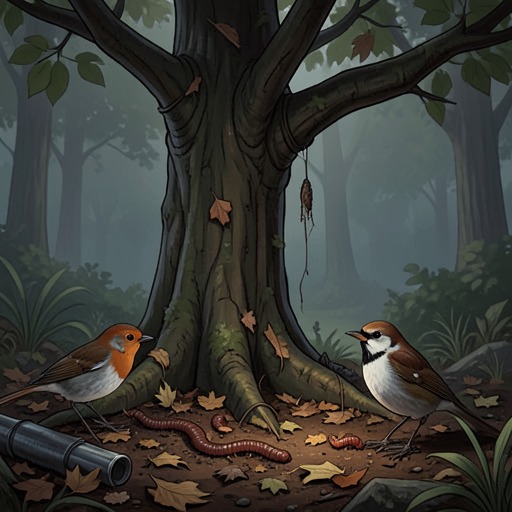
Earthworm
Silent SpringEarthworms occupy two seemingly opposed positions in Silent Spring: they are part of the ecological life of the land, and they can become carriers of pesticides from contaminated ground to wildlife. In the account of Dutch elm disease spraying, they consume treated leaves and accumulate DDT, which then reaches returning robins through their diet. The same route of exposure matters to Woodcocks wintering in Louisiana after fire-ant poison treatments. The earthworm is therefore not merely an organism harmed by contamination; it is also a link through which chemical residues move into animals higher in the food web.
Place in the Land’s Ecology
The book places earthworms within a landscape shaped by long ecological change. In the western plains and on the lower slopes of the mountains, plants and animals evolved under harsh climatic conditions. The sagebrush country is presented not as empty land awaiting improvement but as a living system, with its characteristic vegetation and animal life adapted to one another and to the region’s extremes.
That ecological context makes the earthworm’s role more than a matter of pesticide transfer. Carson contrasts the accumulated adjustments of nature with land-management efforts to replace sage with grass for increased grazing. Such intervention can affect plants beyond its intended targets: in the account of spraying in Bridger National Forest, willows were killed along with sagebrush, altering habitat on which beavers depended. These examples frame the earthworm within a broader argument about interconnected life: changes directed at one part of a landscape can reverberate through organisms and relationships that the intervention did not set out to affect.
From Treated Leaves to Robins
The East Lansing account describes a specific route by which DDT moved from sprayed trees into wildlife. Insecticide left a film on leaves and bark. Rain did not remove it; in autumn, treated elm leaves fell, collected on the ground, and began to decompose. Earthworms feeding in the leaf litter swallowed the insecticide along with the leaves.
Roy Barker’s examination of the worms found DDT deposits throughout their digestive tracts, blood vessels, nerves, and body walls. Some worms died, but others survived with the chemical in their bodies. When robins returned in spring and fed on them, the worms carried the residue onward. As few as eleven large earthworms could provide a lethal dose to a robin, while a bird might eat ten to twelve worms in as many minutes. The figures make the transfer concrete: a dose accumulated in the soil and in prey could become dangerous through an ordinary meal.
The evidence for this indirect route included other animals that had eaten the campus worms. Crayfish fed the worms inadvertently in a research project all died, and a laboratory snake developed violent tremors after being fed them. These observations supported the account’s distinction between direct contact with insecticide and poisoning through contaminated prey. Earthworms thus served as biological concentrators, carrying residues from treated leaf litter into the diets of animals that had not themselves been sprayed.
Exposure Beyond the Spraying Site
The book also traces pesticide residues through earthworms beyond the East Lansing robin deaths. In its discussion of the fire-ant campaign, Woodcocks that wintered in Louisiana and bred farther north were reported to carry residues of the poisons used against fire ants. Their exposure was connected to their feeding habits: Woodcocks probe the ground with their long bills and feed heavily on earthworms. The worms surviving in treated areas could therefore provide a route by which the chemicals reached birds that later moved beyond the treatment site.
This movement complicates the boundaries of a spraying campaign. The target may be local, but contaminated organisms can enter food relationships involving wildlife that migrates between regions. Earthworms connect residue in the ground to a bird’s diet, and the bird’s seasonal movement makes the consequences legible far from the original treatment. The evidence does not make the worm the source of the pesticide; it identifies the worm as an intermediary through which an environmental residue becomes an exposure for wildlife.
Ecological Significance
Across these accounts, earthworms reveal how pesticide effects can travel through ordinary ecological processes rather than remaining where chemicals are applied. Fallen leaves become food for worms; worms become food for birds; residues accumulate and pass along with that food. The chain makes an apparently familiar act of feeding part of a larger process of contamination.
The book’s wider contrast is between the complexity of those relationships and the confidence of broad chemical control. Spraying aimed at a particular insect or plant can leave residues in places and organisms beyond the intended target, while the consequences emerge through linked habitats and diets. Earthworms matter to this argument precisely because they occupy the ground between treated vegetation and wildlife: inconspicuous participants in the land’s life, yet consequential carriers of poison through the food web.